Greetings!
I hope that you are all enjoying the last weeks of the summer. In the rural Pennsylvania community where I grew up, August was traditionally associated with the beginnings of harvest time.
So, it seems a fitting month to focus on how simulation can be used to address issues in rural healthcare.
Rural hospitals face a workforce development challenge that urban academic medical centers do not. These settings typically have fewer staff and less system redundancy, leading to much higher stakes in terms of patient outcomes when any one provider is unprepared. In addition, their relative distance from larger educational hubs can reduce opportunities for provider skills maintenance.
I believe that simulation can have a profound impact on this situation.
Simulation technology is far more portable than it once was, which makes it possible to provide training to providers in outlying communities and rural settings in more reliable and reproducible ways than we could in the past. Simulationists around the world are capitalizing on this reality to develop innovative distributed simulation programs that are making a real difference.
In addition, new grant opportunities exist to develop enduring on-site simulation capabilities in rural settings. The Center for Medicare and Medicaid Services Rural Health Transformation Grants are one such funding mechanism. SSH members in Minnesota, Wisconsin, and New Hampshire are already writing proposals, and it is my hope that even more will take advantage of this.
Finally, it is important to recognize those simulation programs already providing simulation-based instruction in community and rural settings.
Like the institutions they are based in, these programs often have fewer staff, and it can sometimes be difficult for simulationists in these roles to connect with the larger simulation community. To those in these circumstances, know that we see you and are actively exploring solutions. One such program, Simulationists Helping Out With Resources, Experiences, and Solutions (SHORES), has recently been approved and will begin a limited pilot this fall.
Thanks again to each of you for your time, energy, and dedication. You are truly making a difference in the lives of the providers and patients you serve.
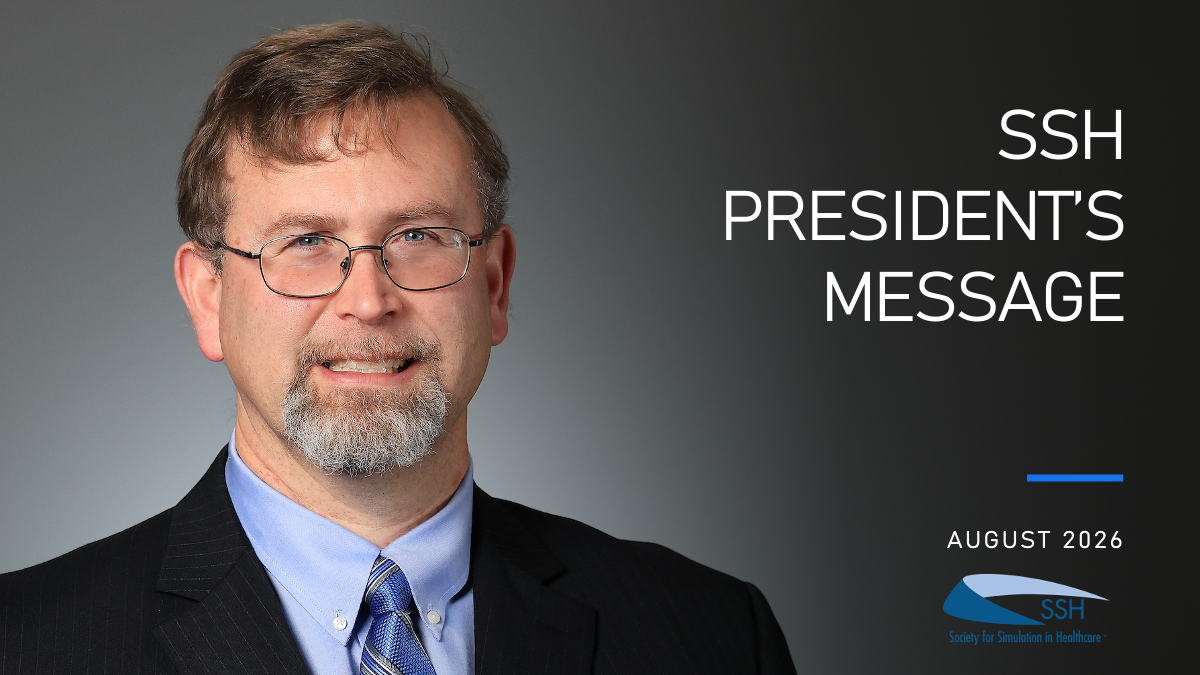
Aaron Calhoun, MD, FSSH
SSH President, 2026-27